By Gracelyn Skilling ’26
It’s finally happening: Massachusetts is on track to get a new flag.
In late August, the advisory commission unveiled the top three finalists (available to view at mass.gov) out of over a thousand public design submissions. Following public hearings, the commission will present their final decision for approval, after which the newly chosen design will take its place on flagpoles across the commonwealth.
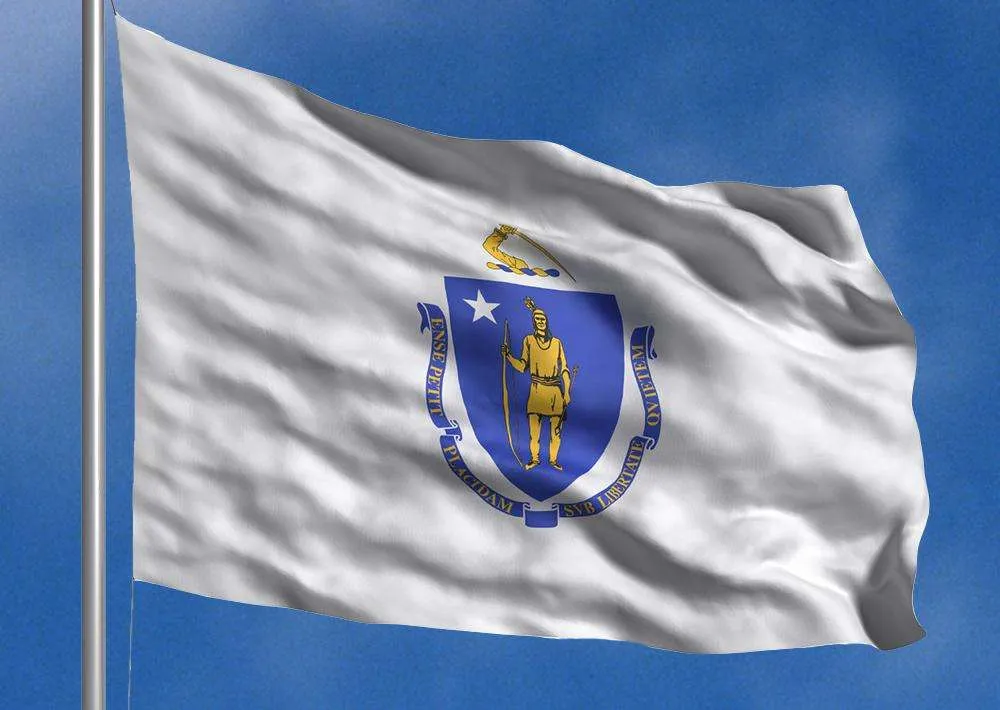
Unless it doesn’t. Which, at the moment, seems increasingly likely, since the flag change has been scooped up as the latest polarizing issue by the thriller-sitcom series that is the current news. But in any case, it’s safe to say that the humble flag has been receiving an unprecedented bout of attention in recent weeks, which is quite the turn of events from its history as a topic of little awareness or interest (which likely factors into why it’s taken so long for it to get an update). Case in point: grab a pencil and draw the Massachusetts flag right now.
You’re squinting into the middle distance, aren’t you? Exactly. Nobody knows what the flag looks like. That, by itself, is half the reason why it needs to go. But it certainly doesn’t end there.
Evaluating a flag is actually quite a simple process. There are five principles of good flag design provided by the North American Vexillological Association, or NAVA (“‘Good’ Flag, ‘Bad’ Flag”):
- Have no seals or lettering.
- Avoid duplicating other flags.
- Be simple enough for a child to draw from memory.
- Use meaningful symbolism.
- Use no more than three colors.
Pretty simple, right? Well, 41 of America’s 50 state flags fail this criteria. This may offer some comfort, at least, in that Massachusetts isn’t alone. Massachusetts’ flag even passes NAVA’s fifth point, which is more than 36 flags can say. However, this may still not redeem it from its shortcomings in regard to the other four points.
1. Have no seals or lettering.
The majority of state flags, including Massachusetts, are made of their seal or coat of arms against a background color; an aesthetic profoundly coined by the NAVA as a “seal on a bedsheet.” Incorporating seals on flags is entirely counterintuitive: the whole appeal of flags is their ability to transgress language and esoterica. Seals are literally made by collaging language and esoterica. At that point, we’d do better to put up a banner declaring “MASSACHUSETTS” instead of a flag—most of the world can’t read English, but nobody reads seal. They’re simply unrecognizable.
That’s one of the reasons why you’ve never seen Massachusetts’ flag—or, say, New York’s or Florida’s or Vermont’s, for that matter—on a T–shirt or bumper sticker like you probably have Texas’ or Puerto Rico’s (uncoincidentally, flags which pass NAVA’s criteria are the ones that are actually used by the general public). The other reason is that seal-on-bedsheet flags look objectively terrible.
2. Avoid duplicating other flags.
Massachusetts uses the same seal-on-bedsheet formula that homogenizes 25 of the USA’s state flags. 21 state flags, in fact, are simply their seal against dark blue, meaning that virtually half the states have the same flag at a distance. Massachusetts thankfully avoids this group, but still yet 2 other flags use seals on a white background. This becomes especially problematic when the wind stops, rendering the flags nebulous white handkerchiefs on a pole. Flags need to be distinct because they need to be recognizable, regardless of whether they’re waving, limp, folded, mutilated, or across the battlefield.
4. Be simple enough for a child to draw from memory.
This flag is complicated; it’s intricate, and it doesn’t mesh as a singular logo. Such is the danger of intricacies on flags: quickly, it begins to look less like a symbol and more like an infographic of the domain’s history and founding ideals—which is exactly what flags are intended to substitute.
3. Use meaningful symbolism.
It’s not that the MA flag fails to deliver symbolism; the issue lies in what that symbolism represents.
As put by the Special Commission Relative to the Seal and Motto of the Commonwealth, Massachusetts’ flag was created by “a small group of men, working in private and emboldened by the prejudices of their time” (Report). More troubling than these undemocratic origins is the design they produced, which is widely interpreted as glorifying the history of violence against Indigenous tribes and as advocating for white supremacy.
There are numerous allusions to this. On the seal, an Algonquian Indigenous person holds a downward-pointing arrow, representing pacification. Above his head is a sword, held with what Edmund Garrett—the flag’s designer—took deliberate care to ensure was a historically accurate grip for a cutting motion (Detmold). Tinseling this gesture is a motto: “By the sword we seek peace …” (Smith). The flag’s history is yet more telling. The military leader to whom the pictured sword belongs is Myles Standish, a name immortalized by his brutality against Indigenous tribes (Detmold). The bow held by the Algonquian Native was modeled from one taken off “an Indian shot and killed in Sudbury” (Edmund Garett qtd. in Detmold); his proportions were derived from a skeleton dug up in Winthrop; and his face is based upon chief Thomas Little Shell, whom Garret selected as “a fine specimen of an Indian” (qtd. in Detmold). The Native’s belt is patterned after Metacomet’s, the leader of the first resistance against English colonization and whose head was mounted on a pike for decades as a trophy (Detmold). For over 50 years, Native leaders have been calling for this flag’s change (“Change the Mass Flag”).
For its undemocratic creation and its disrespect toward Indigenous populations, the Massachusetts flag is not representative of the whole commonwealth nor what it stands for: it does not symbolize liberty, nor justice, nor democracy, or any of the truths that America was founded on and that it prides itself in striving for today.
Many have argued that Massachusetts has more pressing issues to face than changing its flag. But if citizens can’t even agree on a symbol to unify under, or for that matter, what ideals that symbol should represent, how is Massachusetts meant to operate in the interest of its citizens? The flag represents what the government and its citizens stand for—and deciding what we want that to be isn’t a matter we should wait on.
Find out more about the movement to change the Massachusetts flag at changethemassflag.com.
Image: usflagstore.com